Mainflingen
New construction to replace the Main Bridge
Mainhausen, Germany / 2022
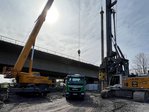
The Main Bridge in Mainflingen on the BAB 45 is now being replaced with an elegant bridle bridge, also known as a false suspension bridge. Construction work is scheduled to begin in 2024. To ensure the load bearing capacity of the deep pylon foundations was sufficient, our Düsseldorf branch worked under contract to Autobahn GmbH North Bavaria to conduct test drilling procedures. The technical adaptation and planning works were conducted in close consultation with PORR Spezialtiefbau Planung and using our in-house measuring equipment. The need to drill down to 50m, difficult soil conditions and enormous test loads of up to 25MN demanded top performance from both team members and equipment.

Facts & Figures
Company
PORR Spezialtiefbau GmbH
Type
Foundations, Measurement technology
Runtime
2022
Extraordinarily high test loads of up to 25MN
Variety both above and beneath the earth
At the bridge site, the Main River forms the state border between Mainhausen in Hesse and Kleinostheim in Bavaria. A slender steel composite structure and the low height of the cable-stayed structure ensure that the replacement structure blends harmoniously into the varied river landscape. The underground geology is also diverse and poses a number of challenges for the special civil engineering work, especially as the bridge is located in the Main's floodplain. Preliminary soil investigations revealed a sequence of Quaternary high flood loams and Quaternary Main terrace over settlement-prone Tertiary clays and sands to sands with sufficient bearing capacity at depths of approx. 25 to 50 m. The piers are therefore being deep-founded with approx. 50 m long large bored piles down to the underlying bedrock.
Perfect cooperation between all competence areas
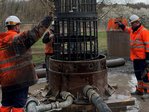
To ensure the load bearing capacity and settling process are satisfactory, the team used cased and slurry-supported reaction and testing piles with diameters of 1,200mm and pile lengths of up to 50m to conduct two static pile tests involving test loads of up to 25MN. The presence of an approx. 26m-thick clay layer interspersed with timber and coal remnants necessitated constant quality control to prevent any untoward reaction with the bentonite slurry used in the process. The bentonite was adapted precisely to suit the geology of the site in the construction site laboratory. Once the piles had been manufactured and cured, the test piles were subjected to test loads between up to 25MN and a breaking load – a situation that called for experts in measurement technologies. The employer was very pleased with the results, as was branch manager André Schürmann: “It is an invaluable advantage, on this kind of ambitious project, for various competence areas – from planning and quality control to civil engineering and measurement – to be able to work together seamlessly.”