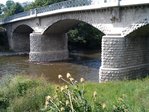
Aachen - Bad Kösen
Saalebrücke
Aachen, Germany / 05.2013 - 04.2014
The listed Saale Bridge near Bad Kösen was built in the early 19th century as a three-span arch bridge made of limestone blocks. As part of a rehabilitation of the substructures, PORR special civil engineering was commissioned to carry out work to ensure the structural stability and restore the historic structure.

Facts & Figures
Company
PORR Spezialtiefbau GmbH
Type
Rehabilitation
Runtime
05.2013 - 04.2014
Injection treatment and restoration of the natural stonework of a historic arch bridge
Rehabilitation of the listed Saale Bridge
The bridge is constructed from masonry and hewn limestone blocks and is a listed building. The aim of the rehabilitation work was to repair the substructures as well as to preserve the historic fabric of the building. The work was carried out in accordance with heritage conservation requirements as well as taking into account the existing structure of the bridge.
Enclosing the bridge for the restoration work
To carry out the drilling, grouting and natural stone restoration work, the structure was enclosed using a suspended scaffolding system. This arrangement enabled work to be carried out on the bridge’s substructures and piers. During the runtime, the works were coordinated with the use of the waterway.
Masonry grouting in piers and abutments
To stabilise the historic masonry, grouting work was carried out in the piers and abutments. For heritage conservation reasons, the boreholes were positioned exclusively in cross joints and bed joints. A core drilling system with a bore diameter of 22 mm was used for this purpose. The boreholes in the abutments reached lengths of up to 6 m.
Injection of ultra-fine cementitious binders
The masonry was grouted using ultra-fine cementitious binders via a low-pressure method. The grouting operations were monitored and documented using measurement and recording equipment. The grout was injected at a rate of approximately 1 l/min. The aim of the work was to fill cracks, fissures and voids in the core masonry of the piers and abutments.
Cleaning and natural stone rehabilitation
Once the grouting work had been completed, the masonry was cleaned using a low-pressure method. Damaged natural stones were replaced with new ones as part of the rehabilitation and integrated into the existing structure. The work served to repair the damaged natural stone areas and preserve the historic appearance.
Contribution to the preservation of the Saale Bridge
The grouting works, the restoration of the natural stone as well as the cleaning of the masonry laid the foundations for the continued use of the listed Saale Bridge. The measures focused on the repair and stabilisation of the substructures, as well as the preservation of the historic building fabric.