Jet grouting

The jet grouting process is a technique used for soil stabilisation and waterproofing in special civil engineering. In this process, the existing soil is broken up by a high-energy jet of fluid (usually a cement slurry) under high pressure and mixed with the binder directly on site. Once set, this forms solid soil-cement bodies.

Jet grouting
in accordance with DIN EN 12716

Soil sealing and stabilisation are among the applications of the jet grouting process (JG), also known as high-pressure injection (HDI). The process is used in special civil engineering to meet a variety of project requirements.

Jet grouting elements can be used to seal construction pit walls and bases, as well as to perform underpinning of the foundations of existing structures. The achievable diameters of the jet grouting elements depend on the geological and site-specific conditions and are determined on a project-by-project basis.

The work is carried out by PORR’s specialist staff using the company’s own equipment, whilst taking into account the relevant technical and project-specific requirements.

Technical brochure
Jet grouting

Applications

DSV columns are used to stabilise and seal the subsoil in loose rock and granular soil in all areas of specialist foundation engineering.

Common uses include:

  • Sealing slabs in construction pits
  • Underpinning buildings and other structures
  • Site remediation (by binding or enclosing pollutants in the soil)
  • Jet grouted shields (as drive protection in tunnelling)
  • Grout curtains
  • Soil stabilisation
  • Sealing blocks
  • Foundations
  • Replacing foundations
Bild zeigt ein Bohrgerät beim Herstellen einer Düsenstrahlsohle in Berlin; Im Hintergrudn sieht man das bekannte Kunstwerk Berlin und im Vordergrund spritzt der Dreck vom Herstellungsprozess der Dichtsohle. Das Düsenstrahlverfahren in einem Bild. Eine Leistung des PORR Spezialtiefbau
Bohrgerät für Düsenstrahlsohle in Berlin
© PORR

Benefits / Features

  • Soil stabilisation and waterproofing: Suitable for stabilising and waterproofing the subsoil.
  • Adaptability: Flexible adaptation of the construction method is possible in the event of changing ground conditions or design requirements.
  • Construction variants: It is possible to produce columns of different sizes, lengths and strengths.
  • Scope of application: Construction of vertical and horizontal slabs, walls as well as three-dimensional structures, such as tunnel profiles.
  • Space requirements: Can also be used where space is limited and working height is restricted.
  • Construction: Low-noise construction with minimal vibrations is possible.
  • Method: A method used for many years, with project-specific procedural instructions.
  • Quality assurance: Construction carried out in accordance with defined quality and monitoring measures.

Basic facts

Jet grouted soil bodies are dimensioned in accordance with:

  • DIN 4093:2015-11 Dimensioning solidified soil bodies – produced by jet  grouting, deep mixing or injection methods.
  • DIN EN 12716: Execution of works in specialist civil engineering – jet grouting works, and the German version of EN 12716:2018
  • General type approval Z-34.4-5 for the “Stump jetting” jet grouting method. (With the publication and introduction of DIN EN 12716:2019-03 "Execution of special civil engineering works - Jet grouting; German version EN 12716:2018" as a technical building regulation, the planning and execution of load-bearing elements using jet grouting or high-pressure injection methods are regulated (see MVV TB, No. 1.2.2.7). A general type approval is no longer required. The use of subsoil improvement methods is permitted by the building authorities and does not require a type approval. More information here)

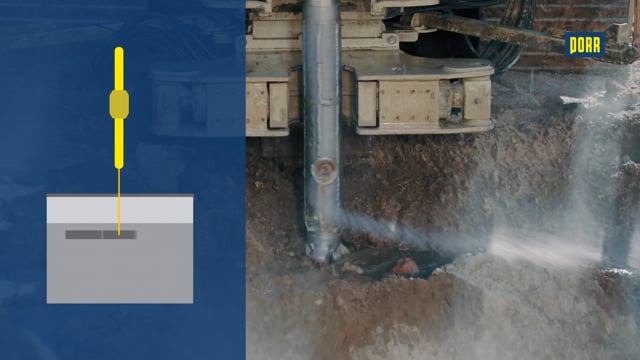
Jet grouting involves dissolving the soil structure with a high-energy jet of fluid/slurry. Cement is added to create a solid body made of soil and concrete or soil and cement.

A special drill string is pushed down to the bottom of the uncased borehole using a rotary drilling motion and drilling fluid. When the string is withdrawn, the surrounding soil is cut open by the rotating cutter jet (a horizontal jet of water and/or slurry with or without an air jacket) and simultaneously mixed with the cement slurry.

The jet grouting method can be used in all types of unconsolidated subsoils. The nozzle shape and jet parameters (withdrawal rate, grout quantity, grout pressure and rotation speed) are selected according to the soil properties.

Quality assurance

We use state-of-the-art jet grouting monitors, high-pressure pumps and mixing systems to meet today’s high standards in jet grouting execution and monitoring. The manufacturing parameters are documented and then digitally evaluated. This enables us to guarantee consistently high standards of quality.

We ensure high execution quality with:

  • Individually coordinated instructions
  • Compliance with the requirements of execution standard DIN EN 12716
  • Clear processes governed by our quality management system in accordance with DIN EN 9001:2015
  • Test columns
  • Borehole measurements
  • Documentation of jet parameters
  • Diameters measured using tactile or sonic measurement technology, oscillation level measurement, tempjet
  • Permeability testing, e.g. by recording thermal data
     

Design variants

Securing foundations

The jet grouting method is the perfect solution for underpinning existing foundations. Underpinning is often necessary when new structures with a deeper foundation level are erected next to existing buildings. The difference in height can be securely bridged with jet grouted elements. The underpinning body is usually shaped like a triangle. The individual jet grout sections are constructed using the back-step method in order to avoid overloading the existing foundations and to minimise subsidence. When working with greater underpinning heights, additional retaining elements such as grouted anchors or micropiles can increase stability. Jet grouting can also be used to stabilise machine foundations that are sensitive to subsidence.

Economical sealing

Lowering the groundwater level for producing deep construction pits in inner-city areas is problematic. In order to circumvent this problem, watertight construction pit enclosures consisting of diaphragm walls or sheet pile walls with sealing floor slabs are frequently the solution of choice. Jet grout columns of up to 5m in diameter can be realised in suitable soils. Combining these slabs with an anti-buoyancy protection system made of micropiles allows for the implementation of very economical design variants.

Rigorous quality control coupled with dynamic adjustment of the design is required for the successful implementation of deep jet grout slabs. Our in-house, highly qualified construction site teams have extensive experience in the implementation of these complex construction tasks. This helps us to ensure safe execution.

Tried and tested in tunnelling

Moving tunnel boring machines in and out of the approach and entry pits is always a challenge, especially when the tunnel is below groundwater level. Sealing blocks made from jet grout are a reliable and economical solution.

These sealing blocks can also be used for inserting and removing tunnel boring machines if the entry pit has not yet been constructed.

Improving the subsoil in soft soils and soils with low load-bearing capacity

In addition to their structural function, jet grout elements can also be used for soil improvement. A grid of jet grouted columns can be used to significantly improve the subsoil, especially in soft soils with low load-bearing capacity. A targeted subsoil survey must be carried out to locate the unsuitable soil areas. The next step is to define which measures are to be taken in order to achieve the desired soil properties.

For aggressive substrate conditions

The jet grouting method is also used to construct micropiles. Jet grouted elements can improve the durability of the grout body, especially in aggressive subsoil conditions. After drilling, the pile borehole, the area where the force is to be applied, is widened using the jet grouting method and the load-bearing element is then incorporated into the newly constructed body.