Green and Lean

Energy and resource considerations
in the planning phase.
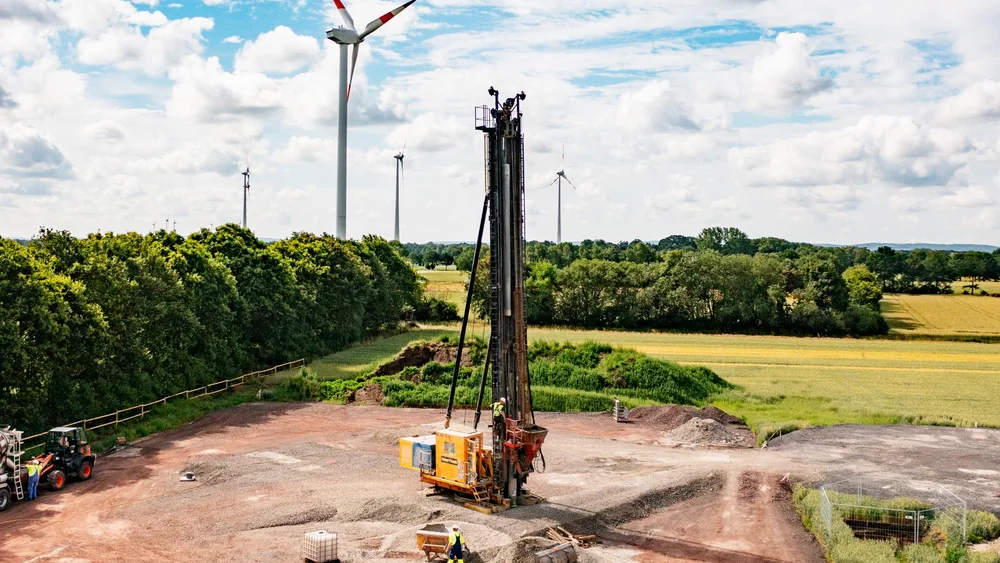
Bild zeigt eine Pfahlgründung bei Stemwede.
© PORR

Through its ‘Green and Lean’ strategy, PORR pursues objectives and measures in the areas of environment, social and governance (ESG). In doing so, economic, environmental and social aspects are taken into account in planning and decision-making processes.

In special civil engineering, various criteria may be taken into account when selecting methods. These include, amongst others, material use, energy consumption, greenhouse gas emissions, as well as project-specific technical and economic requirements.

Taking emissions and resource aspects into account in planning

Different construction options are considered and evaluated as early as the initial planning stages. Information on material use, energy consumption and greenhouse gas emissions can be factored into the selection of suitable methods.

PORR supports clients in evaluating technical alternatives and provides project-specific information on construction methods, material use, emissions and economic conditions. The selection of construction methods takes into account the respective project and site requirements.

Brochure
Sustainability in special civil engineering

What you can expect in this brochure:

  • Sustainable planning improves CO2 footprint
  • Environmentally-friendly products and processes
  • Optimised processes: Benefits thanks to Lean
  • Resource-saving production
  • More transparency: monitoring and documentation
  • Certifications: Additional quality assurance

Processes involving considerations of the environment and resources:

The vibro-compaction method does not require the use of cement. Depending on the project requirements, mineral materials such as gravel or crushed stone can be used.

In the soil mixing method, the existing soil is mixed with a binder suspension. This significantly improves the mechanical and physical properties of the soil. The overlapping of the columns creates a continuous soil mixing wall, which can be used for cut-off walls or to stabilise excavation pits.

In addition to its horizontal sealing function, the soil mixing wall can also perform structural functions.

To prevent pollutants from contaminated soil from entering the groundwater, we can secure the soil using the jet grouting method with overlapping DSV columns. DSV sealing blocks bind the pollutants to prevent them from entering the groundwater. The stabilised soil can subsequently be extracted, sent to soil treatment plants or disposed of in accordance with regulations.

The soft gel injection method is a technique for waterproofing the bases of excavation pits against rising groundwater. The bio-based soft gel used in this process has been granted a general type approval by the German Institute for Building Technology (DIBt). Project-specific data on material usage and greenhouse gas emissions are available for this method.

By using the existing soil, the need for additional material can be reduced, depending on the project. Excavated soil remains in the subsoil and is not completely removed. 

Using a mixer paddle driven by a drive shaft, the in-situ soil is mixed with a cement slurry. This creates a soil-cement structure which, depending on requirements, can fulfil various functions within the construction pits or foundation structure. To create retaining walls with minimal deformation, load-bearing elements can be incorporated into the fresh soil-cement structure.

If you need pile foundations anyway, the additional cost of a near-surface geothermal system is minimal. We’d be happy to consult with you on planning energy piles. This will allow you to heat your home in winter and cool it in summer.

The use of near-surface geothermal energy can be integrated into the energy supply of buildings as part of construction and property development projects. The subsoil serves as both a source and a store of thermal energy. 

In combination with heat pump technologies, geothermal systems can be used to provide heating and cooling. The design depends on the geological, hydrological and planning conditions at the respective site.

With drilling depths of up to 400 metres, PORR taps into geothermal potential for developments that meet a range of project requirements.

Displacement pile systems such as the Frankipile NG® or the atlas pile offer a range of foundation methods suitable for different ground conditions.
Depending on the project requirements and the method chosen, the materials used, the construction process and the volume of soil displaced will vary. As these methods involve the displacement of soil, no conventional drill cuttings are produced. This can be taken into account when planning transport, logistics and disposal strategies.

The selection of suitable pile systems is made taking into account technical, economic as well as project-specific requirements and framework conditions.

We replace contaminated soil with uncontaminated soil using overlapped, cased large boreholes. The drill heads for the replacement boreholes have a diameter of up to 2 metres. The excavated material is then fed into soil treatment plants.

Sustainability certification

DGNB certification for
Construction sites in special civil engineering

We support clients on construction projects for which DGNB certification is sought. PORR Spezialtiefbau holds the DGNB Basic Certificate for ‘Sustainable Construction Site – Special Civil Engineering’. Our standardised construction processes already meet key requirements of the DGNB requirements catalogue and can serve as a basis for the certification of future construction sites.

On request, we assist with the implementation of construction site practices in accordance with the requirements of DGNB certification. The certificate documents compliance with defined criteria and may be taken into account in subsequent building certifications. External certification is carried out by independent third parties and provides verifiable evidence of compliance with the underlying requirements.
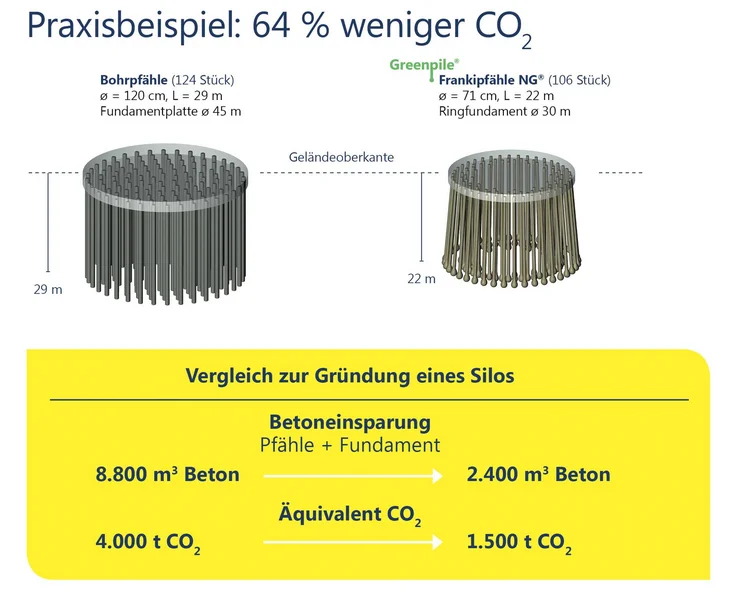
Grafik Nachhaltigkeit im Spezialtiefbau

Example from practice
for the foundations of a silo in Wilhelmshaven.

The following project example illustrates the importance of early procedural decisions in foundation and excavation projects.

For the foundation of a silo in Wilhelmshaven with a total load of around 680 MN, the project was planned and carried out using Frankipiles NG®. During the project development phase, various foundation options were assessed in terms of their technical, economic and project-specific requirements.

Various methods and construction options can be assessed as early as the planning phase. Factors such as material usage, greenhouse gas emissions, the construction sequence, as well as technical and economic conditions can be incorporated into the decision-making process.

Methods used in special civil engineering include, for example, soft gel injection slurries using bio-soft gel to seal construction pits, or various foundation methods for specific ground conditions. The selection is made taking into account the respective project requirements.

No news available.