Bautzen District
A4
Dresden, Germany / 05.2023 - 09.2023
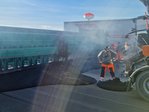
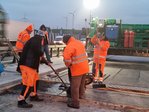
Between the Ohorn and Burkau junctions, the road surface on the Aachen-bound carriageway of the A4 motorway was resurfaced. The work was carried out on behalf of Die Autobahn GmbH des Bundes by a joint venture comprising the Berlin branch and PORR mastic asphalt. A new surface course of mastic asphalt was laid over a length of 4,310 m and a width of 11.50 m. The work was carried out in sections along one of the most important transport routes between Saxony and Poland, even before vehicles were able to use the resurfaced carriageway.
Facts & Figures
Company
PORR Verkehrswegebau GmbH
Type
Highway
Runtime
05.2023 - 09.2023
4,310 metres of new mastic asphalt surfacing for the A4 in the Bautzen district
New road surface on the A4
The eastern section of the A4 motorway connects the Bautzen region with the national long-distance road network. A 3.5 cm-thick surface course of MA 8 S mastic asphalt was laid to renew the carriageway. The asphalt density was 2.450 t/m³. The works comprised the complete laying of the new surface course along the affected section of the motorway.
4,310 metres of carriageway using the mastic asphalt method
Prior to the actual asphalting work, 50 cm wide edge strips of mastic asphalt were laid along the edges of the carriageway. The edges were formed using roof battens. The surface course was then laid in two phases, with widths of 5.40 m and 5.10 m. Mastic asphalt was used, incorporating viscosity-modified bitumen 25/35 VL as well as natural asphalt Trinidad Epuré (TE). Paving was carried out using a chain-wheel screed. As mastic asphalt remains fluid once laid, no additional compaction by rollers was required.
Work within a confined construction area
The works took place within a confined working area. Including the necessary working zones, an installation width of around 7 m was available between the edge of the carriageway and the safety barrier. The individual construction phases were coordinated with the traffic management plan and the boundary conditions of the road section. The base course, main installation and surface treatment were carried out sequentially within the available construction area.
Surface treatment of the carriageway
Following the laying of the asphalt surface course, crushed aggregate was applied in accordance with Method B of the ZTV Asphalt. A total of 11 kg/m² of 2/4-grade aggregate was used. The surface treatment was carried out immediately after the surface course had been laid. This created the new carriageway surface for the section between Ohorn and Burkau.
The basis for continued motorway operation
With the renewal of the surface course, a further section of the A4 has been repaired. Over a length of more than four kilometres, a new road surface was created as part of the transport infrastructure between Bautzen and Dresden. Even before traffic resumed on the renewed section, several thousand square metres of mastic asphalt were laid and the carriageway was renewed in sections.