Oldenburg
Deutsche Bahn rail upgrade
Oldenburg, Germany / 02.2021 - 05.2022
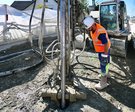
Planning approval section 1 of the Oldenburg–Wilhelmshaven upgrade project, which is approximately 8.9 km long, is located within the city of Oldenburg and the municipality of Rastede. As part of upgrade phase IIIb, ground stabilisation works were carried out in the vicinity of existing railway viaducts. PORR special civil engineering constructed jet-grouted structures to relieve the load on existing retaining walls. A monolithic jet-grouted structure was used across a continuous area.

Facts & Figures
Company
PORR Spiezialtiefbau GmbH
Type
Subsoil improvement
Runtime
02.2021 - 05.2022
Soil stabilisation with jet-grouted columns
Soil stabilisation using DSV columns
As part of the rail link to the JadeWeserPort, the railway line between Wilhelmshaven and Oldenburg is being upgraded and electrified. Much of the route runs over soft subsoil layers. Soil stabilisation measures were therefore required in the vicinity of the Ziegelhofstraße and Pferdemarkt railway overpasses. Jet-grouted piles were constructed to relieve the load on the existing retaining walls. These transfer loads to deeper soil layers and support the existing structure.
Work in the vicinity of railway lines
The work was carried out in the vicinity of existing railway infrastructure and was adapted to the requirements of ongoing railway operations. Personnel, methods and technical equipment pre-qualified for work in railway environments were utilised for the execution of the works. The construction processes were coordinated with the railway operator’s operational constraints. This enabled the specialist civil engineering works to be carried out in parallel with the requirements of the railway environment.
DSV method during railway operations
Before work commenced, test columns were constructed and analysed. The results were incorporated into the implementation planning, the construction sequence and the required curing times for the individual DSV columns. The work was carried out subject to the constraints of ongoing railway operations as well as within defined closure periods.
Work between tracks and overhead lines
The DSV structures were constructed in several phases between tracks, some of which remained in operation. The construction areas were spatially constrained by existing infrastructure, overhead lines and railway operations. For areas where the specified minimum distances from the adjacent track could not be maintained, additional night-time track closures were arranged. During construction, the sequence of works, the necessary progression steps and the respective curing times of the DSV columns had to be integrated into the construction schedule. As well as the limited space between the tracks and the existing overhead lines, the conditions for deploying equipment and materials had to be taken into account.
Foundation for the line upgrade
The construction of the jet-grouted columns laid the groundwork for further upgrade works along this section of the line. The ground stabilisation complements the measures to modernise and electrify the railway line between Oldenburg and Wilhelmshaven.