Sustainable construction site in special civil engineering: the Deutsches Museum is being modernised
/ Special civil engineering / News / Press Release
The Deutsches Museum in Munich is to be modernised in two construction phases by 2028. In addition to the redesign of the exhibition areas, the building fabric will also be renewed in terms of technology, functionality and statics. In order to secure the historic collection building, PORR Spezialtiefbau was commissioned with underpinning and deep foundations. In line with

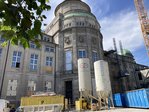
<p>Construction site in front of the Deutsches Museum</p>
The Deutsches Museum calls the complete modernisation of one of the world's most important museums of science and technology, founded in 1903, a ‘project of the century’. Munich occupies a prominent place in the history of concrete construction. In addition to the Hofbräuhaus am Platzl and the present-day Bavarian State Chancellery, the four-wing collection of the Deutsches Museum was also built using what was then the most modern building material. The building is built on a total of 1,500 piles, the final foundation was cast in reinforced concrete and practically all modern concrete construction methods were used in the construction itself. As part of the modernisation, the existing building fabric, which is more than 100 years old, has to be statically reinforced and secured in many places.
Team spirit in confined spaces
In order to create construction pits for supply and technical conduits, the Deutsches Museum awarded PORR Spezialtiefbau Munich the contract for underpinning existing foundations and for the deep foundations of new foundations on the first basement level of the collection building. In total, around 1,200m3 of jet-grouted concrete and 108 micropiles up to 15 metres long and 200 and 250 millimetres in diameter will be constructed.
The limited space available poses a particular challenge. ‘From planning and execution to logistics, we are delivering a cohesive team performance,’ praises site manager Sophia Habermann. PORR Equipment Services is responsible for supplying the compact electric drilling rigs and setting up the construction site, while the Colbitz site is delivering the prefabricated micropiles and PORR Spezialtiefbau Planung is contributing the entire execution planning.
Injection binder with biochar reduces CO2 footprint
The project has been certified by the DGNB as a ‘sustainable construction site in specialised civil engineering’. Among other things, the assessment covers site organisation, resource protection, health and safety, and the quality of construction work.
‘PORR has set itself the goal of becoming a market leader in resource-conscious, recyclable construction. That's why we are always interested in testing new building materials that will help us reduce the CO2 footprint of our construction sites,’ Habermann continues. An innovative and sustainable injection binder is being used in some cases to construct the jet-grouted columns at the Deutsches Museum. The product, developed by Geosystems Spezialbaustoffe, contains biochar. This construction material is able to store CO2 and is therefore one of the interesting solutions for reducing the CO2 footprint in special civil engineering. The general suitability of the product had been demonstrated in advance by the cement manufacturer Rohrdorfer in numerous laboratory tests on construction materials.

If you have any questions, please contact: