Aschersleben
Einetalbrücke
Aschersleben, Germany / 2025
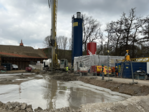
A new bridge link is being constructed along the B180n between the Harz mountain ranges and the river landscape of the Eine Valley. For the construction of the new Eine Valley Bridge, specific geological conditions had to be taken into account even before the actual foundation work began. An underground karst fissure was discovered in the area of the future foundation axis. Cavities and soluble rock layers in the subsoil influenced the planning of the deep foundations and necessitated additional subsoil improvement measures. PORR special civil engineering Berlin was awarded the contract to construct a DSV underpinning structure as the basis for the subsequent bridge foundations.

Facts & Figures
Company
PORR Spezialtiefbau GmbH
Type
Subsoil improvement
Runtime
2025
Subsoil improvement for the foundations of the Einetal Bridge in a karst area
Bridge construction over a karst formation
Karst formations are among the most geologically challenging ground conditions for construction. Natural leaching processes create cavities in the subsoil, which must be taken into account when planning civil engineering structures. In the area of the Einetal Bridge, subsoil improvement was carried out between the future foundation piles and the surveyed cavities. The aim was to create a load-bearing transition between the bridge foundations and the subsoil.
DSV load-bearing slab beneath the foundations
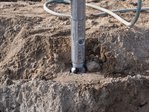
A DSV load-bearing slab measuring approximately 16.5 × 18 m and around 2 m thick was constructed for the subsoil improvement. The slab was constructed using the jet grouting method and positioned between the planned foundation elements and the deeper karst cavities. It forms a continuous ground mass that serves as the basis for load transfer to the future bridge foundations. At the same time, it created an additional barrier between the foundations and the underground cavities in the karst area.
Jet grouting in the subsoil
In the jet grouting process, the existing soil is mixed with a cement slurry and transformed into a new subsoil mass. In this way, a large-scale DSV structure was created beneath the future bridge. The jet grouting bearing slab was tailored to the geological conditions of the site as well as to the requirements of the future bridge foundation. It forms the basis for load distribution between the foundation piles and the underlying subsoil.
Inspections during construction
The construction of the DSV structure was accompanied by project-specific inspection and monitoring measures. These included the recording of construction parameters, the taking of samples and test drilling within the foundation body. The results obtained were used to document and evaluate the subsoil improvement work carried out.
Foundation for the new Einetal Bridge
Even before the bridge’s abutments, piers and superstructure became visible, the foundation for the future bridge was laid deep beneath the ground surface. The construction of the DSV underpinning structure created the conditions necessary for the subsequent construction phases of the new bridge. The subsoil improvement thus forms an essential part of the foundation for the new Einetal Bridge.