Berlin
Pergamon museum
Berlin, Germany / 08.2014 - 02.2018
As part of the Museum Island Master Plan, the PMU II construction pit consortium carried out extensive specialist civil engineering works in and beneath the Pergamon Museum. The client was the Federal Office for Building and Regional Planning. The works form part of the museum’s rehabilitation and the construction of new building sections for the future Archaeological Promenade between the Pergamon Museum, the Bode Museum, the Neues Museum as well as the Altes Museum.

Facts & Figures
Company
PORR Spezialtiefbau GmbH
Type
Underpinning, Rehabilitation
Runtime
08.2014 - 02.2018
Specialised civil engineering works for the rehabilitation of the Pergamon Museum on Museum Island
Special civil engineering works at a UNESCO World Heritage Site
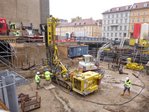
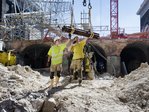
The works were carried out within the listed buildings of Berlin’s Museum Island. The museum remained open to visitors throughout the runtime. The project comprised special civil engineering, underpinning, dewatering, steel construction, excavation and demolition works, all carried out under the specific constraints of a UNESCO World Heritage Site.
Underpinning and watertight construction pits
A total of 21 watertight troughs were constructed for the rehabilitation of the existing foundations and the construction of new structural elements. In addition, extensive underpinning work was carried out using the jet grouting method. The construction pits and underpinning were adapted to the existing historic building structures.
Micro piles and grouting works
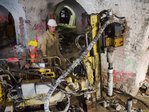
A key component of the works was the installation of around 970 micro piles to depths of up to 30 m. In addition, extensive low-pressure grouting using ultra-fine cements was carried out. These measures served to adapt and stabilise the existing foundation conditions in the museum area.
Water drainage and excavation
Water drainage measures were carried out to enable the construction of the structures. This was supplemented by excavation, steel construction and demolition work. The work was carried out whilst taking into account the existing structures as well as the geotechnical conditions on Museum Island.
Work on the historic structures
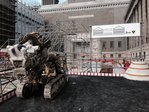
A key focus of the project was the investigation of existing building structures. In the area of the so-called ‘Tempietto’, where the new museum entrance is being built, deep-seated obstacles were encountered. To create sealing slabs, these obstacles had to be cleared to depths of 9.20 m. A rotary drilling rig was used for this purpose.
Temporary bridge for site logistics
A temporary steel bridge approximately 40 m long was constructed to facilitate the installation of the rotary drilling rig, which weighed around 65 t. The bridge was necessary as access to the work area was restricted due to the surrounding buildings and the spatial constraints on Museum Island.
Monitoring during the construction works
The existing Pergamon Museum was continuously monitored whilst the works were in progress. A comprehensive monitoring system was used for this purpose, which recorded changes and movements in the existing structure. Monitoring was carried out throughout all works in the immediate vicinity of the historic building.
Foundation for the further rehabilitation of the Pergamon Museum
The underpinning, micro pile, grouting and excavation works laid the foundations for the subsequent structural and restoration measures. The works combined special civil engineering, the preservation of the existing structure and new construction within the listed ensemble of Berlin’s Museum Island.