Rottendorf
Rothof viaduct
Rottendorf, Germany / 04.2017 - 10.2021
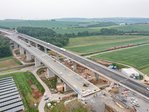
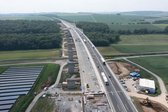
Between the Würzburg-Estenfeld junction and the Biebelried motorway interchange, the Rothof viaduct spans the Würzburg–Rottendorf and Würzburg–Fürth railway lines, as well as the road linking Rothof and Rottendorf. As part of the A7 motorway, one of Germany’s most important north-south corridors, the existing structure, which dated from 1965, was replaced by a new bridge. PORR structural engineering carried out the replacement project between 2017 and 2021. The new bridge was constructed as a two-part prestressed concrete structure and replaces the original composite steel cross-section of the existing structure.
Facts & Figures
Company
PORR GmbH & Co. KGaA
Type
Bridge construction
Runtime
04.2017 - 10.2021
New viaduct for the A7 motorway upgrade
New bridge for the A7 motorway upgrade
The A7 motorway links the north and south of Germany and is being upgraded and modernised in stages. As part of these works, the Rothof bridge was also rebuilt. The new bridge consists of two separate superstructures, each 410 m long. For the planned six-lane expansion of the motorway, the width of each carriageway is 14.50 m. Even before vehicles could travel across the new bridge, the foundations, piers and superstructures were constructed step by step along the route.
410-metre bridge on large bored piles
The Rothof viaduct rests on two abutments and seven pier axes. The largest span lengths are 60 m, whilst the pier heights range from around 12.5 m to 25.5 m. The foundations were constructed using large bored piles with a diameter of 1.50 m and lengths of up to 22 m. These form the basis for transferring the structure’s load into the subsoil. The pile foundations thus created the conditions for the subsequent construction of the substructures and superstructures.
Segmental pushing method over the valley
The two superstructures were constructed using the segmental pushing method. Advance beams approximately 36 m long were used in this process. In a total of 15 stages, the bridge structures – each with a maximum individual length of 30 m – were advanced. This is how the two prestressed concrete box girders were created, which today support the carriageways of the A7. The incremental launching method enabled the superstructures to be constructed in sections whilst railway lines and transport routes continued to operate beneath them.
Transverse shifting of a 17,760-tonne superstructure
A distinctive feature of the project was the traffic management during the runtime. To maintain traffic flow on the A7, the Fulda-bound carriageway was initially constructed on a temporary bypass alongside the existing structure. Following the dismantling of the old bridge, the permanent abutments and piers for both directions of travel were constructed. Subsequently, the second superstructure for the Würzburg-bound carriageway was erected. Finally, the previously constructed superstructure for the Fulda-bound carriageway was shifted transversely. Weighing approximately 17,760 tonnes, the superstructure was moved 19.75 metres into its final position.
Construction between a motorway, railway lines as well as existing infrastructure
The works took place in the immediate vicinity of a busy motorway as well as several railway lines. Construction sequences, traffic management and bridge construction were co-ordinated section by section. Step by step, the new Rothof viaduct took shape amidst existing infrastructure, temporary traffic diversions and new structures.
The basis for the new crossing
The completion of the bridge paved the way for the further modernisation and expansion of the A7 motorway in the Würzburg area. Even before traffic could be channelled over the new superstructures, large-diameter bored piles, piers and prestressed concrete box girders were constructed to form the foundation of the new structure. Thus, between the railway lines, the valley and the motorway, a further section of the transport infrastructure along the A7 was created.