Soil nailing
Encyclopedia: Soil nailing
Soil nailingSecuring construction pits, embankments and changes in ground level
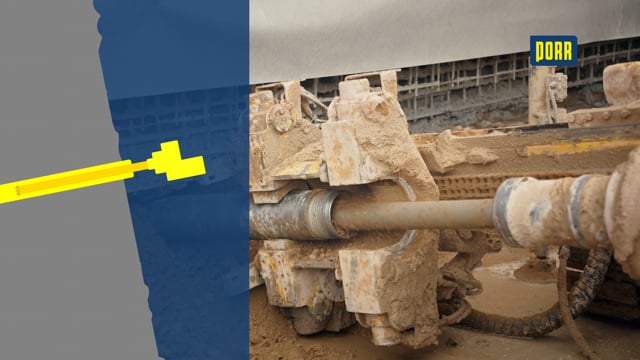
Soil nailing is a method for the temporary or permanent stabilisation of construction pits, slopes and changes in ground level in loose rock or bedrock. Nails and nailed concrete and jetcrete are used to stabilise the areas requiring support. PORR special civil engineering holds a general type approval for this method.
In loose rock, the arrangement of the nails creates a composite soil mass which helps to absorb geotechnical loads. In bedrock, the nails act as structural stabilising elements against the movement of individual rock sections.
The surface is secured using jetcrete. Project-specific geotechnical and structural calculations are carried out for the design and dimensioning of the stabilisation elements. The arrangement and dimensioning are determined taking into account the respective subsoil conditions and project requirements.
Applications
Common uses for jetcrete and soil and rock nails:
- Temporary construction pit systems
- Stabilising slopes and embankments, in some cases also with anchored nets
- Repairing concrete
- Special lightweight load-bearing structures
- Stabilisation during tunnelling works
Benefits / Features
- Adaptability: The shotcrete method can be adapted to different terrain types and combined with Soil nailing.
- Area stabilisation: Can also be used to stabilise larger areas.
- Dry spraying method: Can be carried out even in confined spaces.
- Wet spraying method: Suitable for stabilising larger areas; low dust generation during construction.
- Reinforcement: Depending on project requirements, the addition of steel fibres can eliminate the need for conventional reinforcement.
- Design: Allows for free-form design when constructing structures.
- Additional functions: Depending on the project, jetcrete can also provide fire protection.
Basic facts

Spritzbetonauftrag auf Baustahlbewehrungsmatte.
© PORR
Jetcrete is dimensioned in accordance with:
- DIN EN 14487
- DIN 18551
When testing the load-bearing capacity, the reinforced concrete slab is checked for bending (uniaxial or biaxial) and shear force in order to calculate the steel reinforcement to be inserted. In soil nailing, the punching shear forces are also investigated.
The soil nails can be applied for temporary (< 2 years) or permanent (> 2 years) use. When they are installed for permanent use, the steel supporting element is fitted with an anti-corrosion system consisting of a plastic ribbed tube injected with grout.
Further details are specified in our DIBt-issued general type approval issued:
Z-20.1-104 Stump-Franki soil nailing system.
Quality assurance
We ensure high execution quality with:
- Individually coordinated instructions
- Our own DIBt general type approval for soil nailing Z-20.1-104
- Compliance with the requirements of DIN EN 14487 and DIN 18551
- In-house production of the micropiles in Germany
- In-house and third-party production monitoring
- Clear processes governed by our quality management system in accordance with DIN EN 9001:2015
- Verification of the theoretical pull-out resistance of the soil nails based on professional pile test loads on 3% of all nails
Design variants
There are two design variants with different advantages:
- Dry mix process: A flexible and inexpensive process that can also be applied in confined spaces.
- Wet mix method: This method allows large areas to be secured in a very short time while generating very little dust.
