Cast-in-place concrete driven pilesDeep foundations with full soil displacement
Cast-in-place concrete driven piles are used as deep foundation elements when loads need to be transferred to deeper, load-bearing subsoil layers. Thanks to a range of design options, they can be adapted to suit different subsoil conditions and project requirements. The selection and design are based on the geological, technical and project-specific conditions.
Encyclopedia: Cast-in-place concrete driven piles
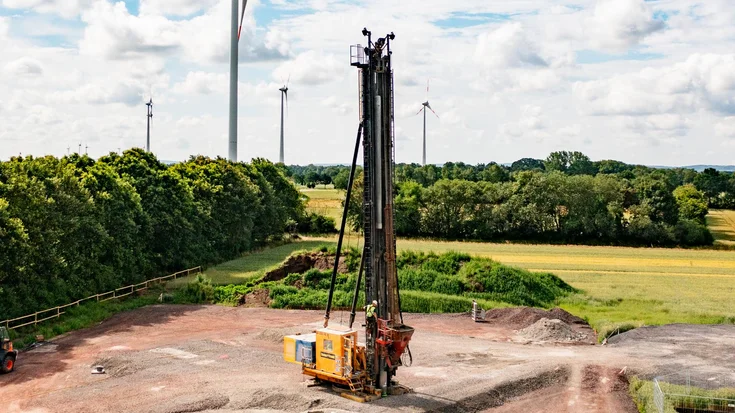
Pile foundations with slender Frankipile NG® piles for the Stemwede wind farm reduce CO2 emissions.
© PORR
Displacement pilesin accordance with DIN EN 12 699
Cast-in-place concrete driven piles are full-displacement piles used in special civil engineering. They are employed as deep foundation elements for various building and infrastructure projects and transfer loads into load-bearing soil layers. They are constructed without conventional soil excavation; instead, the soil is displaced laterally. Installation is carried out dynamically and, depending on the pile type, involves either internal pipe driving or head driving.
We offer the following variants:
Technical brochurecast-in-place concrete piles


Application
We use cast-in-place concrete driven piles as deep foundation elements for all types of structures. These include, amongst others:
- Industrial buildings
- Bridges
- Wind turbines
- Logistics centres
- Residential and commercial buildings
- Office buildings and hotels
Benefits / Features
Cast-in-place concrete driven piles are used as full-displacement piles for a variety of foundation applications. As the soil is completely displaced, no conventional drill cuttings are produced during construction. Pile lengths can be determined on a project-by-project basis, taking into account the ground conditions as well as the resistance values determined during construction.
The benefits / characteristics of driven piles:
- Load transfer: Suitable for a range of load and foundation requirements
- Pile geometry: Adaptation to site-specific ground conditions
- Material usage: Slender pile geometries with concrete requirements tailored to the project
- Ground management: Full-displacement method without conventional drill cuttings
- Scope of application: Suitable for use even on contaminated sites
- Construction: Installation method with project-specific installation speed
- Resistance-settlement behaviour: Design in accordance with project-specific requirements
- Pile inclination: Vertical and inclined piles possible up to an inclination of 4:1
- Energy piles: Versions suitable for geothermal use are possible
- Greenpile®: Cast-in-place concrete driven piles can be used as part of the Greenpile® system
Basic facts
Quality assurance
When constructing cast-in-place concrete driven piles, the requirements of European and national standards, as well as the recommendations of the ‘Piles’ Working Group (EA-Pfähle), must be taken into account. Self-monitoring and documentation of the construction work are governed by the relevant construction standards.
Construction is carried out on the basis of project-specific procedures. The selection and adjustment of construction parameters depend on the respective subsoil conditions, load requirements and project specifications. The specialist equipment is operated by suitably qualified personnel.
Principles of execution
- Project-specific procedural instructions
- Requirements in accordance with DIN EN 12699, Eurocode 7 and EA-Pfähle
- Quality management system in accordance with DIN EN ISO 9001:2015
- Static and dynamic pile load tests
- Pile integrity tests
- Documentation and self-monitoring in accordance with construction standards
Design variants
We always work with our own special equipment and appropriately qualified professionals. Our greatest strength is our ability to adapt to the individual conditions on the construction sites at any time during the project. Our long-standing experience and a wide range of technical possibilities ensure that implementation is always safe and successful.