Frankipile NG®Slim cast-in-place concrete driven pile for a variety of subsoil conditions and load situations
A Frankipile NG® is a cast-in-place concrete driven pile that is constructed without the need for soil excavation and is capable of withstanding particularly high loads. It is primarily used where stable subsoil is only reached at great depths or where high vertical and tensile loads must be safely transferred.
Frankipile NG®Cast-in-place concrete driven pile for heavy loads and deep bearing strata
The Frankipile NG® is used as a deep foundation element when loads need to be transferred to deeper, load-bearing soil layers. Different design variants allow it to be adapted to various subsoil conditions and project requirements. In addition to vertical piles, inclined piles with slopes of up to 4:1 as well as piles designed to withstand tensile and compressive loads can also be constructed.
The method is based on the pile system developed by Edgard Frankignoul, which was first patented in 1908. The design established in Germany, which uses flowable concrete and project-specific base dimensions, is known as the Frankipile NG® (New Generation).
Frankipiles NG® are used as deep foundation elements for, amongst other things:Frankipiles NG® can also be used in construction projects on contaminated sites, as their production as displacement piles does not involve conventional soil excavation. Furthermore, they can be designed as energy piles to integrate geothermal systems into the foundation.
- Bridge structures
- Wind turbines
- Silos
- High-bay storage facilities
- Crane runways
- Dock floors
- Industrial buildings
- Heavy-duty surfaces

Technical brochure Frankipost

Benefits / Features
Various design variants are available to suit different subsoil conditions, load requirements and project specifications. The selection of pile dimensions and design types is made taking into account the geotechnical and project-specific conditions.
Benefits / Features:
- Load transfer: Characteristic pile resistances Rk of up to 12,000 kN are possible
- Soil management: Full-displacement method without conventional soil excavation
- Pile design: The number and length of the piles are determined on a project-by-project basis
- Foundation connection: Can be combined with various foundation structures
- Material usage: Concrete and steel requirements depend on the project
- Resistance-settlement behaviour: Design in accordance with load and ground conditions
- Ground improvement measures: Can be combined with pre-compacting the gravel (KVV)
- Pile fabrication: Limitation of driving depth within the scope of the method’s implementation
- Execution: Comparatively low noise emissions compared to top-driven systems
- Scope of application: Can also be used on contaminated sites
- Energy piles: Can be constructed for geothermal use
Design variants
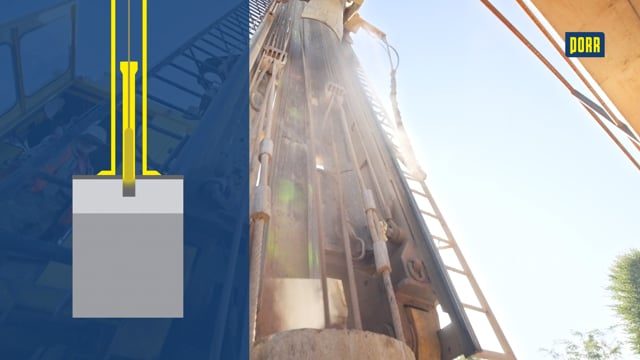
Frankipfahl NG® piles are in-situ concrete driven piles with retrievable casing tubes. The tubes are fitted with a waterproof seal at the base in the form of a plug of dried concrete or gravel sand. A free-falling drive-hammer works inside the casing, striking this plug and driving the tube into the earth. The required ramming force, measured in blows per metre, is an indication of the load bearing capacity of the soil on the site. After reaching the desired depth or meeting the given ramming criteria, the plug is detached and the necessary volume of footing concrete is driven in. Next, a reinforcement cage is installed, concrete filled in and the casing tube is retracted. Frankipfahl NG® piles can be installed perpendicularly or at angles of up to 4:1.

Herstellungsverfahren ohne Kiesvorverdichtung.
© PORR
If the soil at the intended casing landing depth does not have sufficient load bearing capacity, soil improvement measures involving gravel pre-compaction may be undertaken before the pile toe is fabricated. This soil improvement process consists of tamping (compacting) gravel both above and below the intended pile casing landing depth.

© PORR

Optimierungsbeispiel
© PORR
Further development into the Megapile
Since 2009, the Frankipile NG® has also been manufactured with a shaft diameter of 71 cm. This variant is known as the Megapile. Depending on the subsoil conditions, characteristic pile resistances Rk of up to 12,000 kN can be achieved. The design is carried out in accordance with the geological and project-specific boundary conditions.
Areas of application
The Megapile is used as a deep foundation element for structures subject to high vertical loads. Areas of application include, amongst others:
- Bridge structures
- Industrial buildings
- Power plants
- Silos
- Heavy-duty structures
Depending on the project requirements, different foundation and ground-improvement concepts can be implemented through the design of the piles. The selection and design are carried out taking into account the structural, geological and project-specific conditions.

Protection in contaminated soil
Installation in contaminated soil layers
Frankipiles NG® can also be used in construction projects on contaminated sites. As they are manufactured as displacement piles, no conventional soil excavation is required. When driving through contaminated soil layers, various technical measures can be employed depending on the project requirements. These include, for example, 60-degree pile tips or Sealing plugs.
Sealing plugs and pile tips
When installing pile foundations in contaminated soil layers, the project-specific requirements regarding the handling of soil and groundwater must be taken into account. Sealing plugs or special pile tips can be used for this purpose. These measures serve to separate different soil layers during the installation process and are selected in accordance with geological, environmental engineering and project-specific requirements.

Pole protection with a sleeved tube

In the case of particularly weak soft layers, strong groundwater flow or aggressive subsoil conditions, the fresh concrete column of the pile must be supported and/or protected. This is achieved using casing pipes connected to the reinforcement cage.
Quality assurance
Frankipiles are constructed in accordance with the requirements of the applicable European and national standards. Design and manufacture are carried out in accordance with Eurocode 7, DIN EN 12699 as well as the recommendations of the ‘Piles’ Working Group (EA-Pfähle).
Project-specific procedural instructions are drawn up for each construction project. The manufacturing process is documented and monitored in accordance with the requirements of the relevant standards.
Quality assurance measures
- Project-specific procedural instructions
- Compliance with the requirements of DIN EN 12699, Eurocode 7 and EA-Pfähle
- Quality management system in accordance with DIN EN ISO 9001:2015
- Static or dynamic pile load testing
- Pile integrity tests
- Documentation of construction work in accordance with the applicable construction standards


