Wewelsfleth / Wischhafen
SuedLink Elb crossing ElbX
Wewelsfleth / Wischhafen, Germany / 08.2023 - 12.2027
The SuedLink wind power transmission line is a planned direct current link between northern and southern Germany. According to the project developer, it is intended to transport electricity from renewable energy sources in northern Germany to consumption centres in the south. The project also involves an underground crossing beneath the River Elbe. TenneT Germany commissioned PORR to construct a 5.2 km-long tunnel between Schleswig-Holstein and Lower Saxony. High-voltage direct current (HVDC) cables are to be routed through the tunnel in future. The structure is being constructed at a depth of around 40 metres using mechanical tunnelling with tubbing lining. Various PORR specialist divisions are involved in the project, including tunnelling, structural engineering and special civil engineering, as well as overall BIM coordination by pde Integrale Planung.

Facts & Figures
Company
PORR GmbH & Co. KGaA, PORR Spezialtiefbau GmbH, pde Integrale Planung GmbH
Type
Alles aus einer Hand, Tunneling, Supply and disposal facilities, Turnkey construction pits
Runtime
08.2023 - 12.2027
A tunnel 20 m under the Elbe
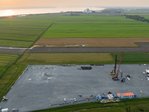
Construction of the ElbX Elbe crossing officially began with the symbolic ground-breaking ceremony in Wewelsfleth in September 2023. Immediately following the launch, preparatory work commenced, including the construction of site access roads, before the teams of special civil engineering began excavating the starting pit. Subsequently, preparations for the receiving excavation pit also got underway on the Lower Saxony side in Wischhafen.
Challenging diaphragm wall works in winter
During the diaphragm wall works, a granite-gneiss boulder lying at a depth of around 27 metres was recovered shortly before Christmas. By early 2024, 44 diaphragm walls had been constructed for the launch pit, the diaphragm wall box and the socket structure. In addition, 549 Displacement piles were installed to stabilise the designated cable support areas.
Commencement of excavation and construction of the underwater concrete base of the launch pit
In spring 2024, the works entered a new phase: once the diaphragm walls had been completed, the first layer of stiffening was installed in April. Shortly afterwards, the wet excavation of around 25,000 m³ of marsh soil began. As no pressure pipe could be laid for water level regulation, the process water required to counteract buoyancy had to be supplied by other means. The excavation base and the diaphragm wall faces were closely monitored throughout the works. Industrial divers removed sludge and suspended sediment and prepared the site for the construction of the underwater concrete base, the installation of which began in June 2024.
Factory acceptance testing of the tunnel boring machine
Meanwhile, preparations were underway for one of the project’s major milestones: the manufacture of the tunnel boring machine. In July 2024, factory acceptance testing of the 700-tonne tunnel boring machine took place at the Schwanau plant. The mixing shield was designed for the ground conditions expected in the project. These include clay, loam, peat, sand, gravel, as well as stones and boulders. Following acceptance, the machine was dismantled, transported to Wewelsfleth and reassembled in the launch pit.
Construction of the shaft buildings on both sides of the Elbe
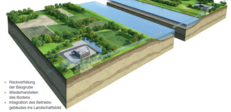
In parallel with the tunnel boring, the shaft structures were built on both sides of the Elbe. The shafts will later be used to connect the six 525 kV DC cables to the tunnel and the jointing buildings. In addition, above-ground operations buildings are being constructed.
Start of tunnel boring in early 2025
Mechanised tunnel boring began in February 2025. The tunnel boring machine, christened ‘Elsa’, reached the halfway point of the planned tunnel route in December 2025. In the sections beneath the riverbed, it passed through Lauenburg clay, amongst other materials. Below the navigation channel, compressed air work at pressures of up to 4.8 bar was required. As a result, operating times at the cutting wheel were limited to around 50 minutes per shift. The breakthrough took place in June 2026.
Progress on the shaft structures
Whilst tunnelling work was underway, progress was also being made on the shaft structures: in Schleswig-Holstein, the second basement level was completed, whilst in Lower Saxony, work was underway on the fifth basement level.
With the completion of the target excavation pit in 2025, the conditions were in place for the TBM ‘Elsa’ to break through at the target shaft in mid-2026.
Prerequisite for the SuedLink’s crossing of the Elbe
The ElbX tunnel provides the structural basis for routing the planned SuedLink direct-current cables between Schleswig-Holstein and Lower Saxony under the Elbe. The necessary infrastructure is being created step by step through tunnel boring, the construction of shafts as well as joint structures, as well as the subsequent construction of operational buildings. ElbX forms part of the northern section of the SuedLink, for which TenneT Germany is responsible. Various PORR specialist departments from the fields of tunnelling, special civil engineering, structural engineering and planning are collaborating on the project.