Berlin
Closing the gap in the U5 and fitting out the station at Rotes Rathaus
Berlin, Germany / 04.2016 - 12.2019
The completion of the missing section of Berlin’s U5 underground line created a continuous link between Alexanderplatz and the Brandenburg Gate. The approximately 2.2 km-long section connected the existing U5 line with the former U55 line. To this end, two new tunnel tubes were constructed using shield tunnelling over a length of around 1.6 km to the west of the Rotes Rathaus. The eastern section of the project comprised the complete refurbishment of the four-track Alex Tunnel, as well as the construction of the track layout, as well as the shell and fit-out of the Rotes Rathaus station. PORR structural engineering was responsible for the execution of this section.

Facts & Figures
Company
PORR GmbH & Co. KGaA
Type
Rail and road tunnels
Runtime
04.2016 - 12.2019
Underground link between Alexanderplatz and the Brandenburg Gate
Rehabilitation of the Alex Tunnel
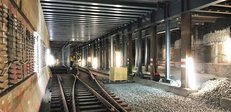
The Alex Tunnel, which is approximately 350 m long, is about 15 m wide and between 4.70 m and 8.90 m high. Its upper edge lies, on average, around 3.50 m below the road surface. This means that the existing structure is largely situated within the groundwater zone. For site logistics, two covered delivery openings, each measuring 10.60 × 4.60 metres and equipped for crane operations, were constructed. These openings enabled machinery, equipment and building materials to be moved into and out of the tunnel without disrupting ongoing underground railway services. The access openings thus formed the link between the construction site beneath Berlin’s city centre and the work areas within the existing tunnel.
Ballasting in the groundwater zone
The gutting of the existing tunnel temporarily altered its weight and structural system during the rehabilitation. To account for buoyancy conditions at each stage of construction, the tunnel sections were ballasted in a controlled manner. Pressure-controlled jacks were also used when installing new and additional supports. The rehabilitation was carried out in sections using the ‘pilgrim’s step’ method, with working widths of around 1.50 m each. Surveying monitoring accompanied the work and documented the movements and changes in the structure during the individual rehabilitation phases.
Step by step through the existing structure
The rehabilitation of the almost 100-year-old tunnel was carried out in small, successive sections. Existing structures were dismantled, supplemented or replaced, whilst the structural conditions of the tunnel were taken into account at every stage. Ballasting, pressing, surveying and the section-by-section construction process were all interlinked. This is how the structural foundation for the new U5 line operations was created within the historic tunnel cross-section.
Extension of the Rotes Rathaus station
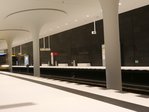
The extension of the three-storey Rotes Rathaus station took place at a later stage than the tunnel refurbishment. The works encompassed the public and non-public areas of the station on levels -1 to -3. The fit-out work included glazing, joinery, metalwork, plastering and tiling. In addition, technical systems were installed for lifts, ventilation and air conditioning, building automation, sanitary facilities, fire protection and underground railway operations. The coordination of the fit-out trades and the building services was carried out under the leadership of PORR Ingenieurbau.
Mushroom-head columns and terrazzo surfaces
The station’s appearance is characterised by centrally positioned mushroom-head columns. The walls are clad with light and dark terrazzo slabs. Glazed mezzanine levels create visual connections between the various areas of the station. The design draws on motifs from the historic city layout around the Rotes Rathaus and combines them with the requirements of a modern underground station.
From the existing tunnel to a continuous underground line
With the rehabilitation of the Alex Tunnel and the extension of the Rotes Rathaus station, a historic section of tunnel has become part of the continuous U5 line through the centre of Berlin. Where the tunnel had ended since 1930, the line now continues towards Museum Island, Unter den Linden and the Brandenburg Gate. Beneath the surface, a structure that is almost 100 years old, new tunnel tubes, track systems and a new station are integrated into a single section of the line.