Munich
Living in Nockherberg Mitte
Munich, Germany / 11.2018 - 12.2022
Acting as the main contractor for Bayerische Hausbau GmbH & Co. KG, PORR developed the ‘Wohnen am Nockherberg Mitte’ residential sub-development on the former production and logistics site of the Paulaner Brewery in Munich. The scope of work included the detailed design for the architecture and building services, as well as the turnkey construction of the Nockherberg Mitte development.

Facts & Figures
Company
PORR GmbH & Co. KGaA
Type
Residential construction, Commercial building
Runtime
11.2018 - 12.2022
Residential and commercial development on the site of the former brewery
Neighbourhood development on a former brewery site
The construction project forms part of the development of a site covering approximately 90,000 m² on the Nockherberg. A quarter comprising residential, commercial buildings and infrastructure areas has been created on the former brewery site.
Residential quarter with 293 flats
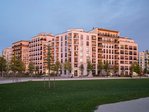
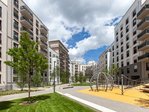
The project comprises 16 buildings with a total of 293 residential units. The residential buildings were designed as a cohesive block development and are characterised by varying building heights as well as individual façade designs.
Commercial spaces on the ground floor
Small-scale commercial units have been created on the ground floors along Regerstraße. These spaces complement the residential use and form an integral part of the neighbourhood concept.
Underground car park with 349 parking spaces
An underground car park, partly comprising three storeys, with 349 parking spaces was constructed beneath the buildings. The underground car park provides access to the quarter and forms the project’s central parking infrastructure.
Architecture and façade concept
The 16 buildings were designed with varying façade arrangements. Despite their individual designs, the building masses are grouped together to form a cohesive block structure. The varying building heights characterise the quarter’s skyline and structure the development within the site.
Planning using BIM
The planning for service phases 1 to 4 was provided by the client and reviewed and further developed by PORR. As part of the project work, optimisations were developed for structural engineering, building services, façades and Outdoor facilities. The BIM (Building Information Modelling) method was used for project coordination and updating the cost estimate. The modelling facilitated coordination between the individual design disciplines as well as the preparation of variant and decision-making documents.
A foundation for residential and commercial buildings
The ‘Wohnen am Nockherberg Mitte’ project involved the creation of 293 flats, commercial buildings and a three-storey underground car park with 349 parking spaces within a quarter on a former brewery site covering approximately 90,000 m². The construction project comprises residential, commercial and infrastructure areas, as well as the detailed design and turnkey construction of the quarter.