Grouted anchorAnchoring systems for construction pits, slope stabilisation and civil engineering structures
The vibro-compaction method is used for subsoil improvement in soils with low bearing capacity. This involves creating compacted columns of mineral materials, such as gravel or crushed stone, within the subsoil. The work is carried out on a project-by-project basis, taking into account the geotechnical and structural requirements.
Encyclopedia: Grouted anchor
Grouted anchors in accordance with DIN EN 1537Anchoring systems for construction pits, changes in ground level and civil engineering structures
Grouted anchors are used as anchoring elements – usually as pre-stressed anchors – to stabilise construction pits, changes in ground level or transport routes.
Various drilling methods are available for creating the boreholes. The different design variants allow for adaptation to varying subsoil conditions and site circumstances. The selection of the anchor system and design is made in accordance with the technical and project-specific requirements.
Using our own drilling rigs, boreholes can be drilled even where working height is limited, space is restricted or special site conditions apply.
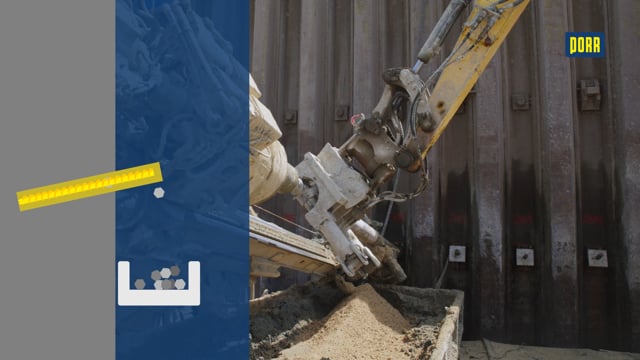
Technical brochureGrouted anchor

Applications
Grouted anchors are used to anchor construction pit walls such as diaphragm walls or bored pile walls. Underpinning elements can also be anchored back using grouted anchors. If anchoring is not possible for any reason, bracing can be used as an alternative.
Common uses for grouted anchors include:
- Temporary construction pit systems
- Embankment reinforcements
- Anti-buoyancy control
- Dam rehabilitation
- Rope bracing
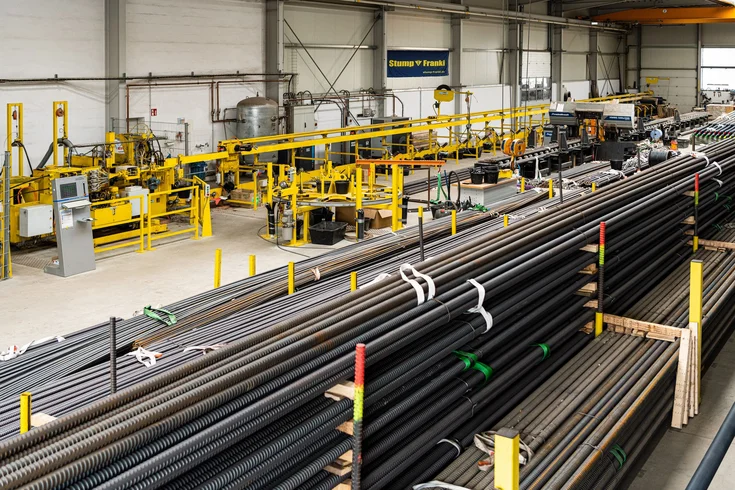
Eigene Produktion in Deutschland: PORR Spezialtiefbau verfügt über eigene allgemeine Bauartgenehmigungen für Litzenanker in Boden und Fels. Die Verpressanker werden zentral in unserer Fertigungshalle in Colbitz zusammengesetzt.
© PORR
Benefits / Features
Thanks to a range of anchor systems and design variants, grouted anchors can be adapted to different subsoil conditions and project requirements. The anchor system is selected in accordance with the geological, technical and site-specific conditions.
- Adaptability: Can be adapted to different subsoil and site conditions.
- Construction pit design: Grouted anchors can be installed within the construction pit without the need for additional bracing elements.
- Anchor forces: The permissible anchor forces are designed on a project-by-project basis, taking into account the geological and technical conditions.
- Installation: Low-noise installation with minimal vibrations is possible.
- Design variants: Can be supplied as removable anchors.
- Operating conditions: Can also be used where working height is limited and space is restricted.
- Type approvals: General type approvals for grouted anchors are available from the German Institute for Building Technology (DIBt).
- Quality assurance: Installation carried out in accordance with defined quality and monitoring measures.
- Drilling methods: Different drilling methods can be used depending on the subsoil conditions and project requirements.
- Suspected presence of explosive ordnance: Can also be used in construction projects where the absence of explosive ordnance has not been confirmed; the relevant permit under Section 7 of the Explosives Act is in place.
- Production: Grouted anchors are manufactured at our own production facilities in Germany.
Basic facts
Quality assurance
We ensure high execution quality with:
- Individually coordinated instructions
- Our own DIBt general type approval for grouted anchors
- Compliance with the requirements of execution standard DIN EN 1537
- In-house production of the grouted anchors in Germany
- In-house and third-party production monitoring
- Clear processes via our quality management system in accordance with DIN EN 9001:2015
- Suitability and acceptance tests in accordance with DIN EN 1537
Design variants
Grouted anchors are available as strand anchors or bar anchors. Different design variants are available depending on the service life, corrosion protection, load requirements and ground conditions.
- Temporary anchors / short-term anchors
Service life of up to two years
Short-term anchors with a service life of up to two years, as specified in DIN EN 1537, are used, amongst other things, for construction pits. Corrosion protection is specified in the standard. Both single-bar anchors and strand anchors are used for short-term anchors.
Extended service life
If the intended service life is exceeded, project-specific measures must be defined. This may include, for example, adjustments to the corrosion protection on the anchor head or the use of suitable strand designs.
- Permanent anchors
Anchoring systems for long-term applications
Permanent anchors are used, amongst other things, for slopes, terrain steps and other permanent anchoring tasks.
In this context, requirements relating to corrosion protection, transport, installation and the durability of the load-bearing member are taken into account. The design is carried out in accordance with the applicable standards as well as project-specific specifications.
Anchor forces
Permanent anchors can be designed for typical anchor forces of up to 7,500 kN. They are manufactured on the basis of defined production, testing and monitoring processes.
- Flush drilling method
Drilling methods for different subsoil conditions
In the flush drilling method, cuttings are removed via an external flushing system. The method is adapted to the respective subsoil conditions and project requirements.
Compact equipment and a range of site set-ups enable deployment across projects of varying sizes and under different boundary conditions.
- Pressure-sensitive drilling
Drilling in areas where explosive ordnance is suspected
Pressure-sensitive drilling can be used in areas where the absence of explosive ordnance has not been confirmed.
The work is carried out under the supervision of suitably qualified experts in accordance with the applicable legal requirements. PORR special civil engineering holds the necessary permits for these services in accordance with the Explosives Act.
- Staggered anchors
Anchoring systems in soils with low bearing capacity
Staggered anchors can be used in ground conditions where force transmission is limited.
Principle of the staggered anchor
In staggered anchors, the load-bearing lengths of individual strands are arranged at different depths and converge in a common anchor head.
By distributing the load over different depths, different soil layers can be utilised in load transfer.
- Removable anchors
Systems for planned demolition works
In construction projects in inner-city areas or near existing infrastructure, there may be requirements for the partial or complete dismantling of grouted anchors.
Various dismantling systems are available for these applications. The selection is based on the ground conditions, the anchor lengths and the project requirements.
- Drilling entry points below the water table
Grouted anchors under special boundary conditions
Where the groundwater level is high or the construction pits are deep, grouted anchors with insertion points below the water table may be required.
Planning and installation are carried out taking into account the geotechnical, hydrogeological and project-specific requirements. This may necessitate preparatory measures as early as the construction of the construction pits.

