Atlas pile
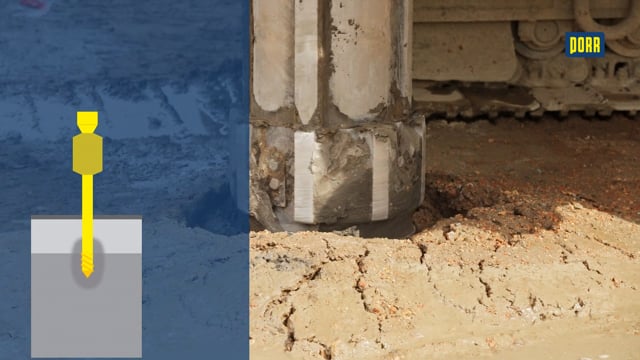
Atlas piles are full displacement drilled piles with a helical shaft. They are installed quietly and without causing vibrations, achieve high load-bearing capacities and are particularly suitable for demanding foundations in inner-city areas.
Encyclopedia: Full displacement piles
Atlas pilein accordance with DIN EN 12 699
Atlas piles are full displacement drilled piles and belong to the group of Screw piles. They are installed without causing vibrations and with minimal noise, and are particularly suitable for inner-city construction projects as well as for use in the immediate vicinity of sensitive structures.
As the soil is completely displaced, no drill cuttings are produced. This reduces the costs associated with transport and disposal. Furthermore, the method is suitable for use in contaminated soils.
A characteristic feature of the atlas pile is its screw-like pile shaft with high skin friction. As a result, the pile system achieves high bearing capacities whilst making efficient use of materials, and is suitable for a wide variety of construction projects.
Typical areas of application include:
- Residential and commercial buildings
- Office buildings
- Hotels
- Logistics centres
- Industrial buildings
- Retrofitting foundations for existing structures
- Construction projects with high requirements for vibration and noise protection
Technical brochurefull displacement bored piles

Benefits / Features
Atlas piles can be adapted to different subsoil conditions and project requirements through various design variants. The pile system is selected taking into account the geological, technical and structural constraints.
- Construction: Low-noise construction with minimal vibrations is possible.
- Load-bearing capacity: Depending on the design variant, characteristic pile resistances of up to 4,000 kN are possible.
- Design: High skin friction due to complete soil displacement.
- Operating conditions: Suitable for use in contaminated soils, as no excavated soil is removed. Installation is also possible where working height is limited and space is confined.
- Design: Vertical and inclined piles up to an inclination of 4:1.
- Energy piles: Designs suitable for geothermal applications are possible
Basic facts
Quality assurance
The construction of atlas piles requires precise planning and continuous monitoring of all construction parameters. In addition to the experience of the site team, the professional operation of specialist equipment plays a crucial role in achieving the required pile resistances and a high standard of workmanship.
The applicable European and national standards, as well as the recognised recommendations for specialised civil engineering, are of paramount importance in this regard. In-house monitoring and comprehensive documentation of the construction work are an integral part of the construction process.
The following measures in particular contribute to a high standard of workmanship:
- Project-specific procedural instructions and coordinated construction concepts.
- Execution in accordance with DIN EN 12699, Eurocode 7 as well as the recommendations of the Working Group on Piles (EA-Pfähle).
- Quality assurance via a certified quality management system in accordance with DIN EN ISO 9001.
- Static and dynamic pile load tests to verify load-bearing capacity.
- Integrity tests to check pile quality and geometry.


