Now the tunnel beneath Hanover is taking shape
Hannover, / Structural engineering
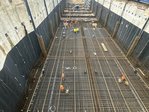
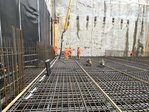
Hanover is moving forward with one of its most important infrastructure projects: PORR has reached a crucial milestone with the first concrete pour for the tunnel on the Südschnellweg. What has so far been prepared mainly below ground is now becoming increasingly visible. At a depth of around 18 metres, the first floor slab for a section of the tunnel was poured – effectively the foundation for the future structure. Around 440 cubic metres of concrete were used for this.

In rund 18 Metern Tiefe wurde die erste Bodenplatte für einen Tunnelabschnitt gegossen.
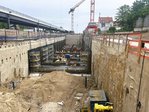
Months of intensive preparatory work preceded this step. Since the end of 2024, work has been underway in the area of the Südschnellweg to clear the site, demolish buildings and existing structures, and excavate large construction pits. At the same time, several so-called ‘construction docks’ – clearly demarcated construction sections – were created, within which the tunnel is now taking shape step by step.
“With the first concrete pour for the tunnel floor, we are entering the phase in which the tunnel is taking shape,” explains Timo Kögel, site manager at PORR Ingenieurbau. “What has so far mainly involved planning and preparation is now visibly developing into a structure.”
Tunnel grows section by section
The new tunnel is being built in many individual sections, much like a jigsaw puzzle being pieced together bit by bit. In total, over 100 such structural elements are being created, which will later form the continuous tunnel.
This construction method has a major advantage, as it allows for a flexible response to the conditions in the urban area and enables the route to be optimally adapted. At the same time, a clearly structured construction process ensures that the work progresses efficiently and in a controlled manner.
A major project in the heart of the city
The scale of the project is impressive: a total of around 300,000 cubic metres of soil has been excavated – an enormous logistical challenge for the construction team in an inner-city setting. At the same time, the excavation pits had to be secured and stabilised before the actual tunnel construction could even begin. All of this has now been completed and the groundwork for the structural shell is in place.
Step by step towards easing the strain on Hanover
With the start of the concrete works, the construction site will now undergo visible changes. In the coming months, further sections of the tunnel will take shape, whilst new construction areas are prepared in parallel.
The structural work is expected to be largely completed by the end of 2029. This will mark the completion of a key component of Hannover’s future transport infrastructure. The aim is to improve the capacity of the Südschnellweg and bring about a noticeable reduction in traffic congestion for the city’s residents.
If you have any questions, please contact:

Further interesting articles from the topic area
Back to overview PORR Group
IGO Industries Group sells PORR shares
 Structural engineering
The hoisting of the heavy-gauge steel plates marks a significant milestone in the construction of the Horb viaduct
 Structural engineering
On schedule and on track: bridge structures in Marzahn largely complete
 Building construction
PORR Hochbau West hands over the Commerhof residential development in Kaarst
 Tunneling
ElbX Elbe crossing has reached the breakthrough stage
 Career
Careers built by PORR: Five reasons to celebrate – and a strong signal to the region’s young talent
 Career
Living in solidarity for 100 years
 Structural engineering
900 cubic meters of concrete mark the next phase of construction at the Güterplatz subway station
 Special civil engineering